Tracing Pathways From Sign-Up Protocols to Habit Formation in Emerging Smartphone Gaming Networks
Harper Schmidt · Aug 14, 2026

Tracing Pathways From Sign-Up Protocols to Habit Formation in Emerging Smartphone Gaming Networks
Emerging smartphone gaming networks rely on structured sign-up protocols that guide users through verification, profile creation, and initial engagement steps, and these processes connect directly to longer-term habit formation patterns. Data from industry tracking shows that streamlined registration flows reduce drop-off rates during the first session, while subsequent triggers like daily login reminders and progress tracking encourage repeated access. In August 2026, mobile gaming platforms reported increased retention metrics tied to integrated onboarding sequences that blend identity checks with immediate gameplay access.
Initial Registration and Onboarding Mechanisms
Sign-up protocols typically begin with email or social account linkage followed by age verification and device authentication, and these steps establish baseline user data that platforms use to customize early experiences. Research indicates that apps incorporating quick tutorial modules during registration see higher completion rates, since users move from setup directly into core mechanics without friction. Observers note that platforms in regions such as Canada and Australia have adopted standardized verification layers that comply with local regulations while maintaining seamless transitions into gameplay.
Once basic accounts activate, many networks introduce progressive reward structures that start with small achievements and scale in complexity, and this layering helps convert one-time users into regular participants. Studies from academic sources reveal that variable reward schedules introduced early in the user journey align with established behavioral reinforcement principles, thereby strengthening the connection between sign-up completion and ongoing engagement.
Transition From Onboarding to Sustained Interaction
After the initial sign-up phase, platforms deploy notification systems and in-app prompts that reference prior activity, and these elements create feedback loops that reinforce routine access. Figures from regulatory reports demonstrate that networks utilizing personalized challenge lists experience measurable lifts in session frequency within the first thirty days. Those who have examined user flow data find that seamless movement from verification to habit cues depends on consistent interface design across devices.
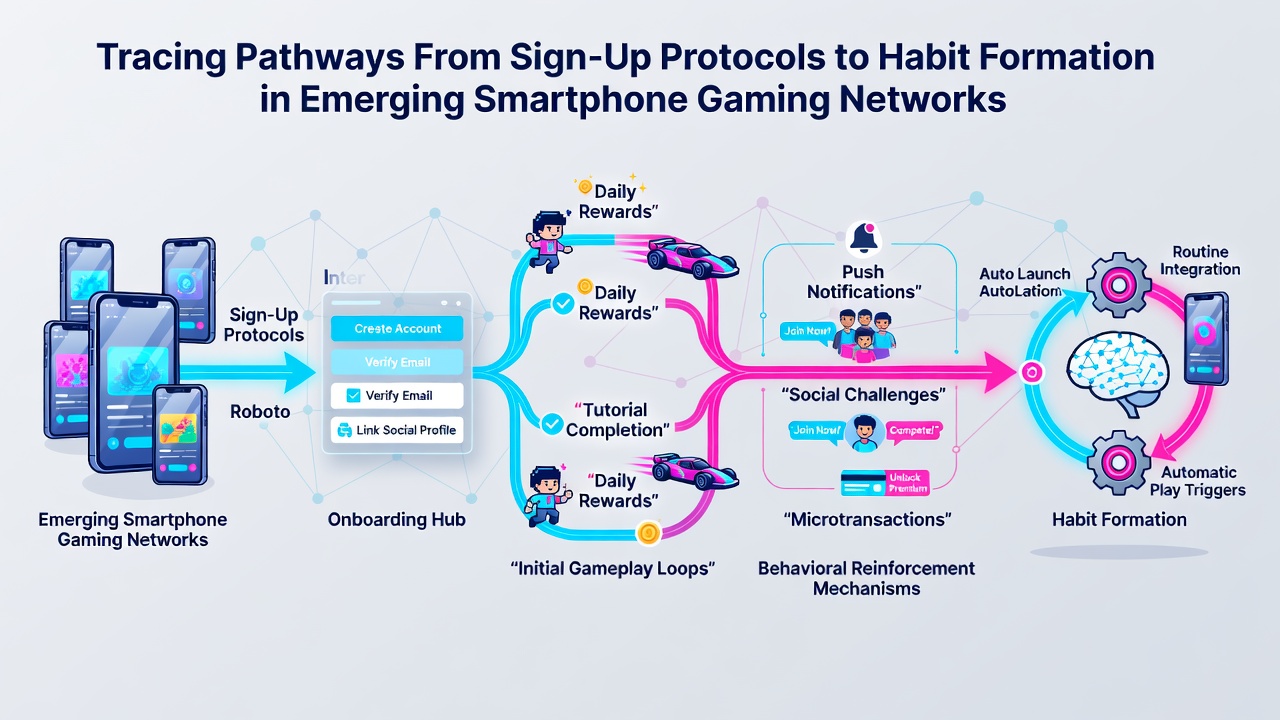
Habit formation accelerates when platforms embed social features that link new accounts to existing player communities, and this integration supplies external validation that sustains motivation beyond solitary play. Evidence suggests that cross-border networks operating in multiple jurisdictions adjust these features to match regional preferences while preserving the underlying progression pathways. In practice, users who complete verification and receive immediate community integration show stronger patterns of daily returns compared with those who encounter delayed social options.
Data Patterns and Retention Indicators
Analytics collected across emerging networks illustrate that the interval between sign-up and first repeat session narrows when platforms apply targeted nudges derived from early behavior logs, and these adjustments correlate with broader retention statistics. Reports compiled by the Pennsylvania Gaming Control Board highlight rising participation rates in mobile segments where onboarding incorporates adaptive difficulty scaling. Similarly, research published through the Canadian Gaming Association links structured reward pathways to extended user lifecycles in app-based environments.
Network operators track metrics such as average sessions per week and cumulative playtime, and these indicators reveal how initial protocols influence later stages of engagement. Data shows that users who encounter balanced challenge-reward sequences shortly after registration maintain higher activity levels over subsequent months, whereas abrupt difficulty spikes correlate with earlier disengagement.
Behavioral Frameworks in Practice
Habit formation models applied to smartphone gaming emphasize cue-routine-reward cycles that begin during sign-up and evolve through repeated interactions, and platforms operationalize these models by aligning interface elements with user milestones. Those who have studied longitudinal datasets observe that networks emphasizing consistent daily cues achieve steadier growth in active user bases across diverse markets. European regulatory summaries from the Malta Gaming Authority further document how verification-integrated habit loops contribute to predictable engagement trajectories without requiring additional promotional layers.
Case examples from expanding Asian markets illustrate that localized onboarding variations still follow core pathways linking registration data to sustained play patterns, and this consistency supports scalable network growth. Researchers continue to examine how device-specific features such as push notification timing and biometric login options refine these pathways in real time.
Conclusion
Pathways originating in sign-up protocols extend through layered engagement tools and culminate in measurable habit formation across emerging smartphone gaming networks, and ongoing data collection supports continued refinement of these sequences. Regulatory bodies and research institutions track these developments to maintain compliance while documenting shifts in user behavior. The connection between structured entry processes and long-term interaction remains a central focus for platform operators seeking stable growth metrics.